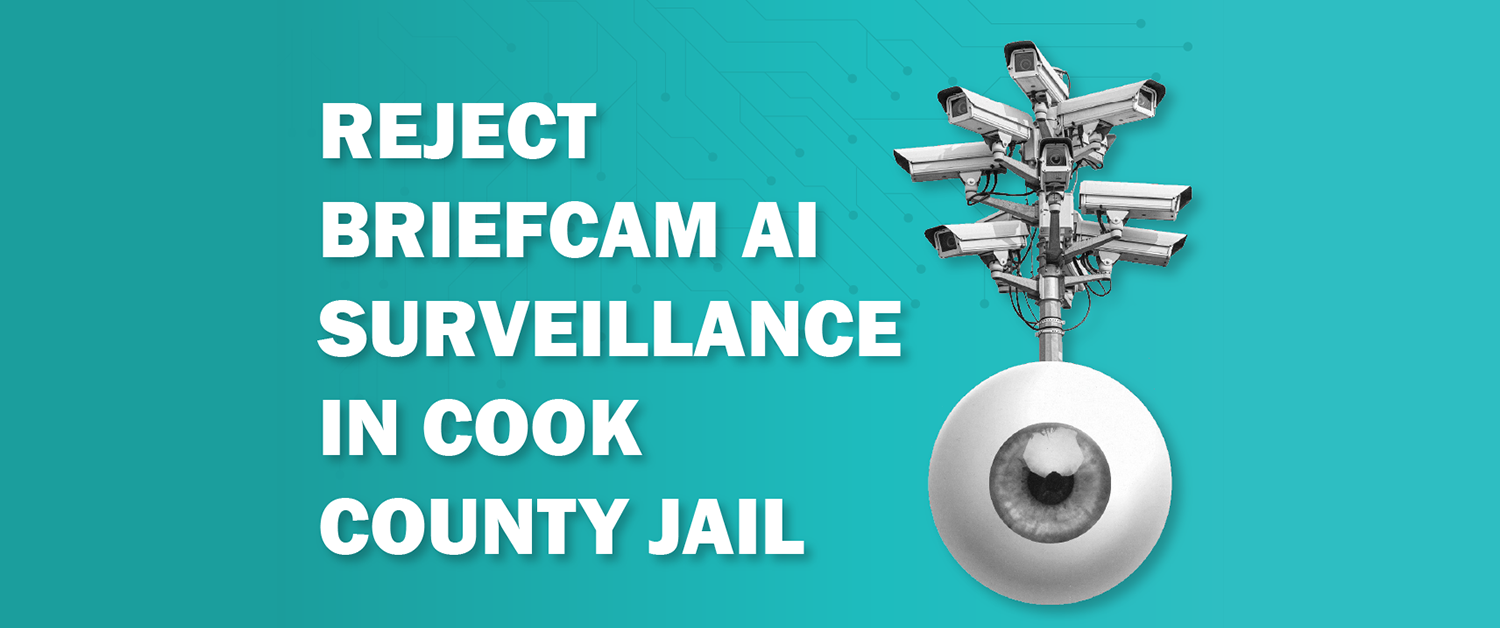

REJECT BRIEFCAM AI SURVEILLANCE IN COOK COUNTY JAIL
In recent years, Cook County Jail has had a dramatic increase in the number of incarcerated people who have lost their lives. The jail experienced its highest mortality rate on record in 2023, with more people dying than during the pandemic. Nine people incarcerated in the jail lost their lives in 2025, and Sheriff’s Officers are being investigated for criminal behavior in relation to one of these deaths.
These deaths are the result of people not receiving timely medical care while overdosing, guards not being present during physical altercations due to cross-watching, and violence from sheriff’s deputies and other incarcerated people. Cook County must protect the health, safety, privacy, and civil rights of every person in the Sheriff’s custody. The County Board has the opportunity to take the human rights crisis inside the jail seriously by demanding transparency, reviewing the Sheriff’s management of the jail, and investing in proven, human-centered solutions — not untested AI surveillance technology.
THE RISK
LAWSUITS FOR CIVIL RIGHTS & PRIVACY VIOLATIONS: Briefcam was effectively banned by French courts due to privacy concerns and false positives that led to civil rights violations.
AI ENABLED CAMERAS CREATE LONG-TERM PRIVACY RISKS: BriefCam is an invasive privacy destroying technology that facilitates constant surveillance of everyone moving in and out of the jail in retrospect and real time, and there are no legal safeguards on the government’s collection and use of surveillance data or sensitive unique biometric identifiers. Visitors, friends, family members, children, legal counsel, volunteers, employees, and people in jail, many who have not been convicted of a crime, will have their information collected, analyzed, and assessed by algorithms and stored in a centralized database maintained, accessed, and used at the behest of the Cook County Jail. It is not clear who will have access to that data, how long it will be retained, whether it could be shared with other law enforcement agencies and under what conditions, and how this extremely sensitive data will be protected. It is also impossible to predict how policies will change over time.
FALSE ALERTS CAN CREATE NEW SAFETY PROBLEMS: AI systems are unreliable and can misread behavior, misidentify people, and flag activity that is not actually dangerous. In a jail, those errors can trigger inappropriate law enforcement responses, escalate tension, and create unnecessary and potentially harmful contact between staff and incarcerated people.
FACIAL RECOGNITION CAN WORSEN RACIAL PROFILING: Facial recognition systems have repeatedly been shown to perform worse on Black faces and other marginalized groups. Using this technology in a jail where 68% of people incarcerated are Black creates a serious risk of misidentification, false accusations, and discriminatory enforcement.
AI CANNOT REPLACE REQUIRED HUMAN OBSERVATION: State law requires personal visual checks of people in custody every 30 minutes. A recent audit revealed that Cook County was not in compliance with cell check standards nearly 20% of the time. The County should not allow technology to become a substitute for the human oversight required to keep people alive.
COSTS COULD GROW OVER TIME: The initial contract may not reflect the full long-term cost of the system. Software updates, expanded camera capacity, hardware upgrades, maintenance, staff training, litigation, and future add-ons could increase the County’s financial burden. Cook County has seen this pattern before: the Sheriff’s Office previously sought millions for a helicopter, then later returned for additional operating funds. Commissioners should not approve another costly law enforcement technology without a full accounting of the true present and future costs, uses, limits, and public value.
WE CAN’T PREDICT ALL THE NECESSARY GUARDRAILS: AI technology is changing rapidly. Tech companies are regularly introducing new uses for this emerging technology, many of which are free of oversight and could create new civil rights and privacy concerns.
A SAFER PATH FORWARD
Cook County should reject BriefCam and instead invest in proven solutions that address the actual conditions inside the jail. The County Board should:
- Require public release and review of any proposed surveillance contract.
- Follow up on the 2024 hearing on deaths in Cook County Jail.
- Holistically review the human rights crisis at Cook County Jail by reviewing the Sheriff’s use of staffing, cross-watching, safety checks, and medical response practices.
- Ensure that people in custody receive timely health care, overdose response, mental health care, and substance use support.
- Reassign Sheriff’s staff from its former electronic monitoring program and deployments that are duplicative of Chicago Police activity in the South Loop and Magnificent Mile toward the office’s core responsibility: safely overseeing the jail.
Cook County does not need an AI surveillance experiment inside the jail. It needs investments that actually keep people alive.
Money spent on BriefCam is money that could be used to fill urgent gaps in health care, housing, treatment, and essential human services — the very supports that make communities safer and reduce the number of people entering the jail. Cook County must choose real safety over surveillance.
Take Action! Tell Your Commissioner to VOTE NO on BriefCam!
Click this link to send a letter to your commissioner!