
Community Court-Watching Report Details Second Year of Pretrial Fairness Act Implementation
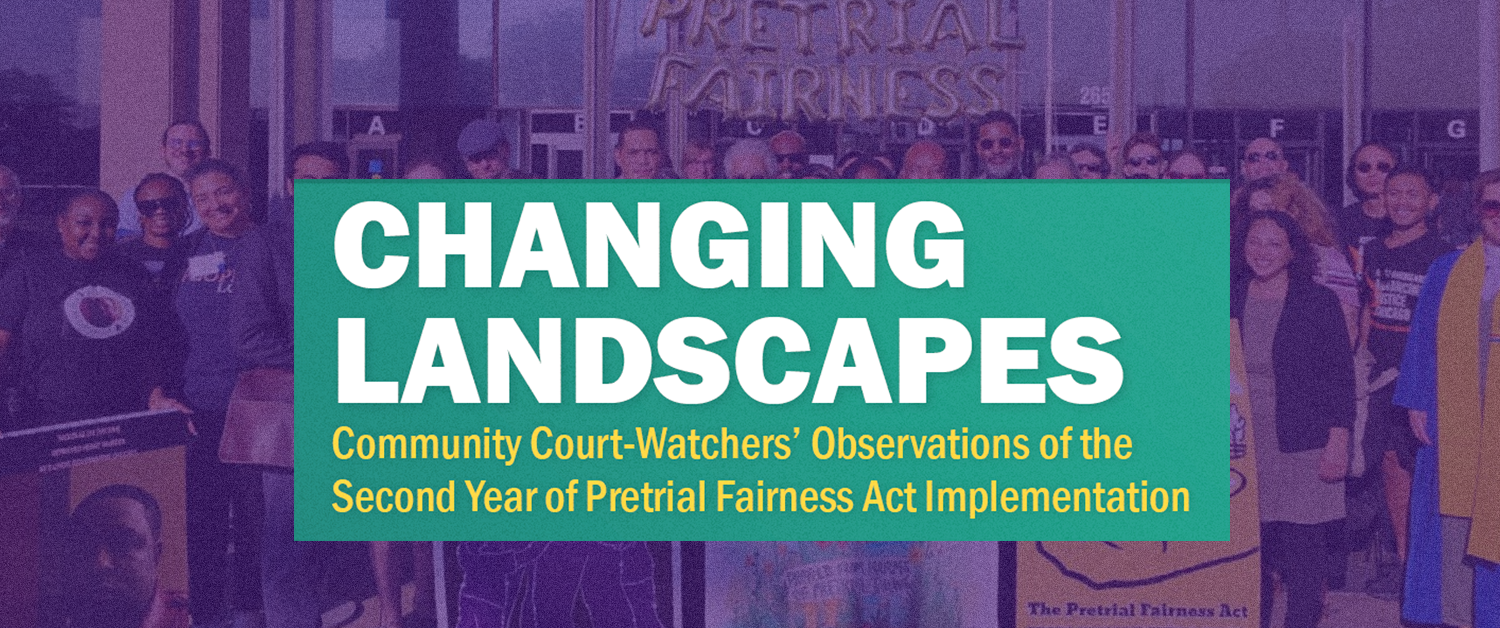
Today, the Illinois Network for Pretrial Justice is proud to share “Changing Landscapes: Community Court-Watchers’ Observations of the Second Year of Pretrial Fairness Act Implementation,” a new report detailing community efforts to monitor implementation of the Pretrial Fairness Act in its second year. In Spring 2025, we trained more than 50 community members to observe and document detention hearings at the Leighton Criminal Courthouse for a one-month period.
- Read the new report “Changing Landscapes: Community Court-Watchers’ Observations of the Second Year of Pretrial Fairness Act Implementation” here.
- You can read a summary of the report’s key findings and recommendations for improving implementation here.
Thousands of everyday people came together to end the unjust practice of jailing people simply because they were too poor to pay the price placed on their freedom. We believe that if our communities are going to see the full potential of the Pretrial Fairness Act, we must all be engaged to ensure the law is being properly implemented which is why we brought people together to observe these hearings. Since the law took effect, the number of people jailed pretrial statewide has decreased, and we’ve simultaneously seen a reduction in violent and property crime. While we are encouraged by the numbers, our report makes clear that there is more we can do to see the full potential of this historic reform.
Though court-watchers witnessed judges continuing to spend more time deciding detention outcomes than they had under the money bond system, their observations reveal that individual court actors’ recent application of the law has led to less individualized detention hearings than when the law was first implemented. Their observations shed light on why pretrial jailing has increased in Cook County despite the strong limits on detention set by the Pretrial Fairness Act.
Court-watchers repeatedly cited the ways in which decision-making has become less holistic than when the law first took effect. When State’s Attorney Burke took office, she implemented a policy requiring her prosecutors to seek detention for people whenever certain charges and factors are present, regardless of the facts of the case or the circumstances of the individuals. This has led to an increase in detention motions and prosecutors relying on inflammatory arguments rather than facts, effectively pressuring judges to incarcerate more community members.
Key findings from “Changing Landscapes: Community Court-Watchers’ Observations of the Second Year of Pretrial Fairness Act Implementation”:
- 96% of accused people that prosecutors sought to jail were Black or Latine, and most were young men.
- Judges granted 74% of prosecutors’ petitions to detain. One court-watcher noted, “It seems as though the default decision is to detain–the burden of proof seems to be on the defense rather than the prosecutor.” (The law places the burden on the prosecution). This is especially concerning given that approximately half of the detention-eligible cases filed result in dismissal or acquittal.
- Over two-thirds of detention petitions were filed against people accused of possessing, but not using, a gun. Prosecutors and judges were inclined to regard anyone accused of simply possessing a gun as dangerous, even though many people who carry guns do so for their own protection, not because they intend to cause harm. Judges granted detention petitions in 70.3% of these cases.
- A low risk assessment score signals that a judge should release a person, and yet, of the 30.5% of the people with a low score, judges detained or subjected 80.4% of these people to electronic monitoring.
Illinois made the right decision by ending money bail, but two years after implementation it is clear that court stakeholders need to do more to ensure that our communities are fully benefiting from this historic civil rights legislation. We hope that court stakeholders will engage with the recommendations made in our report and work with advocates to return Cook County to its status of being a leader in pretrial justice reform.
Join us on online on July 30th at 12pm for a presentation on the reports key findings and a discussion on state of implementation in our state’s largest court system with Cook County Public Defender Sharone R. Mitchell Jr., State Senator Robert Peters and State Rep. Lisa Davis. Register here.